
Does Beef Tallow Clog Pores? The Truth About Tallow Balm for Acne-Prone Skin
For anyone who has battled stubborn breakouts, cystic bumps, or chronically oily skin, the advice has always been the same: strictly avoid oils, look for "oil-free" labels, and strip surface shine at all costs.
Hearing that rendered beef fat (tallow) is one of the most effective solutions for balancing breakout-prone skin sounds completely counterintuitive. The immediate question every acne sufferer asks is: Does beef tallow clog pores?
The short answer is: No, pure grass-fed beef tallow does not inherently clog pores. When formulated correctly, it can actually help resolve the root causes of persistent adult and hormonal breakouts.
In this guide, formulated through the lens of clinical aromatherapy and herbal medicine, we break down the science of comedogenic ratings, the lipid profile of human sebum versus beef fat, and how to use tallow balm to clear reactive skin without congesting your pores.
The Comedogenic Scale: Where Does Beef Tallow Rank?
The comedogenic scale ranks cosmetic ingredients from 0 to 5 based on their likelihood of clogging pores (forming comedones):
0: Will not clog pores at all (e.g., Argan oil)
1–2: Low comedogenic risk; well tolerated by most acne-prone skin types (e.g., Jojoba oil, Rosehip oil)
3: Moderate risk
4–5: High likelihood of clogging pores (e.g., Coconut oil, Wheat germ oil, Cocoa butter)
Grass-fed beef tallow rates at approximately a 2 on the comedogenic scale.
Unlike pore-clogging vegetable shortenings or heavy coconut oil, tallow has a low-to-mild comedogenic rating. It shares this tier with beloved facial oils like jojoba and squalane. Most individuals with acne-prone or oily complexions use pure grass-fed tallow without experiencing clogged pores or micro-comedones.
The Science of Sebum: Why Your Skin Recognizes Tallow
To understand why tallow does not congest your pores, look at the biological makeup of healthy human skin.
In Latin, the word sebum translates directly to tallow. Human sebum and rendered tallow from pasture-raised cattle share an almost identical fatty acid architecture:
Palmitic & Stearic Acids: Saturated fatty acids that constitute the foundation of human skin's lipid barrier. They create a protective shield that prevents Transepidermal Water Loss (TEWL) and keeps environmental pathogens out.
Oleic Acid: A deeply penetrating monounsaturated fatty acid that acts as a natural delivery mechanism, shuttling nutrients deep past the stratum corneum rather than pooling in pore openings.
Conjugated Linoleic Acid (CLA): An anti-inflammatory fatty acid concentrated in pasture-raised, grass-finished cattle. Research shows that acne-prone skin often suffers from deficient linoleic acid in its natural sebum, leading to thick, sticky oils that trap dead skin cells. The bio-available lipids in grass-fed tallow help normalize this balance.
Because tallow mirrors your skin’s biological lipid blueprint, your cellular receptors recognize it as natural sebum. Instead of sitting on the surface like an impenetrable sheet of synthetic mineral oil, it absorbs directly to nourish your tissue.
The Real Root of Breakouts: The Stripped-Barrier Rebound
Most acne treatments—benzoyl peroxide gels, harsh foaming cleansers, and high-percentage salicylic washes—work by drying the skin.
While stripping away oil temporarily dries surface blemishes, it triggers a destructive biological chain reaction:
Harsh Cleansers / Stripping Actives
               │
               ▼
   Damaged Skin Barrier (Micro-tears)
               │
               ▼
   Spike in Moisture Loss (TEWL)
               │
               ▼
   Rebound Sebum Production (Hyper-Seborrhea)
               │
               ▼
Sticky, Oxidized Oil Trapped in Pores ──► Inflammatory Breakouts
When your moisture barrier is compromised, your sebaceous glands panic and overproduce sticky, low-quality sebum to prevent dehydration.
Applying a small dab of grass-fed tallow halts this panic cycle. It replenishes essential lipids, restores the barrier, and signals to your sebaceous glands that your skin is already hydrated. Over 2 to 4 weeks, natural sebum production balances out, reducing overall oiliness and pore congestion.
Why Formulation Matters: The Synergy of Tallow, Manuka Honey & Turmeric
Not all tallow balms are created equal. Using raw, unrefined suet from grain-fed feedlot cattle can introduce inflammatory impurities and a heavy, unpleasant aroma to your face.
To achieve clear, radiant skin, pasture-raised suet must be purified and paired with functional, blemish-clearing botanicals:
100% Grass-Fed & Finished Tallow: Only pasture-raised tallow contains concentrated levels of fat-soluble vitamins (A, D, E, and K) and anti-inflammatory CLA. Vitamin A acts as nature’s bio-compatible retinol, encouraging cellular turnover without chemical peeling.
Active Manuka Honey (The Antibacterial Purifier): High-grade Manuka honey contains methylglyoxal (MGO), an active compound that inhibits Cutibacterium acnes (the bacteria responsible for inflammatory breakouts) while acting as a natural humectant that draws water into dehydrated skin cells.
Turmeric Root (The Redness Reducer): Rich in curcumin, turmeric calms post-inflammatory erythema (PIE)—the red, purple marks left behind by past blemishes—and eases the swelling of active bumps.
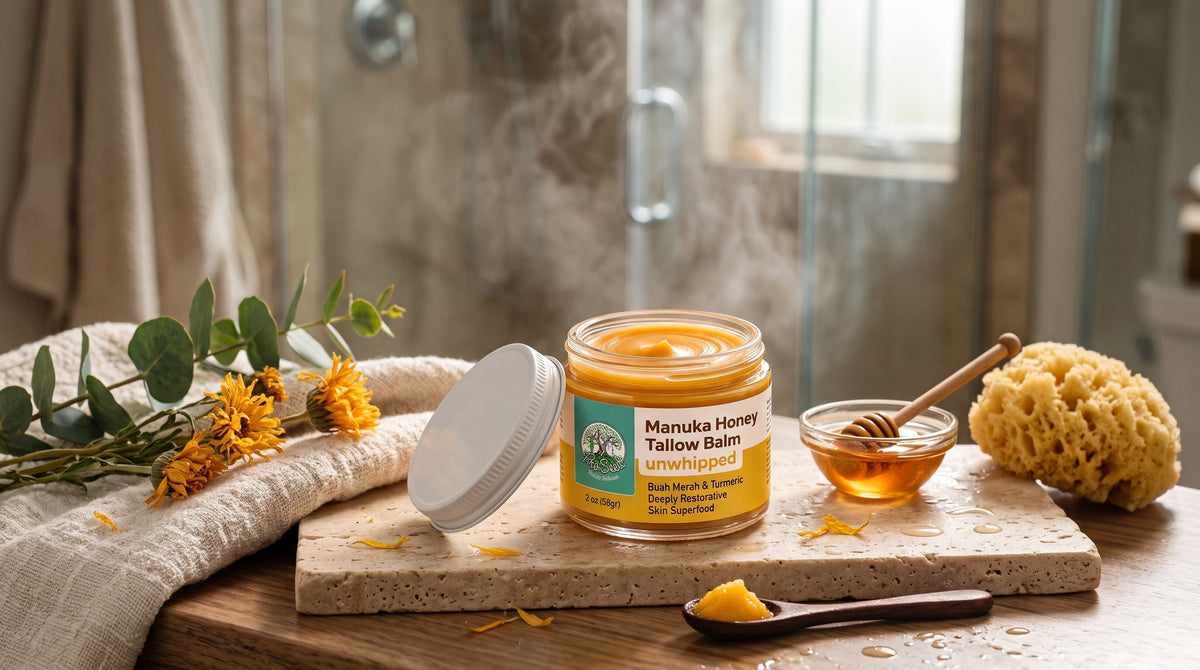
Formulated for Balance: Discover the clarifying power of our small-batch ProSeed Manuka Honey Tallow Balm—crafted with grass-fed tallow, raw active manuka honey, and soothing turmeric to nourish and balance sensitive, acne-prone skin.
How to Use Tallow Balm on Acne-Prone Skin (Without Breaking Out)
Using a concentrated, water-free balm requires a different technique than using a standard water-based lotion. Follow these guidelines:
1. The "Pea-Sized" Rule
Tallow balm contains zero water fillers, emulsifiers, or liquid waxes. A tiny amount—roughly half the size of a pea—is plenty for your entire face. Applying a thick layer will overwhelm your skin’s absorption rate.
2. Apply to Damp Skin
Always apply tallow balm immediately after washing your face while skin is still slightly damp, or after misting with pure rosewater. The balm locks in moisture, sealing hydration deep into the epidermis.
3. Melt Before Applying
Rub the balm between clean fingertips for 2 to 3 seconds until it melts into a light, golden liquid. Gently press and pat it across your face rather than rubbing vigorously.
4. Understand the Adjustment Window
If your skin has been stripped by chemical treatments for years, your barrier may experience an adjustment period of 5 to 7 days as your sebum production regulates and dead surface cells slough off.
Frequently Asked Questions (FAQs)
Can I use tallow balm if I have cystic or hormonal acne?
Yes. Hormonal and cystic acne are driven by internal inflammation and deep follicular swelling. The conjugated linoleic acid (CLA) in grass-fed tallow and the curcumin in turmeric calm deep tissue inflammation, while manuka honey provides gentle topical microbial support.
Will tallow balm make my oily skin look shinier during the day?
When applied in the correct amount (a tiny pea-sized dab onto damp skin), tallow absorbs into a smooth, semi-matte satin finish within 5 to 10 minutes. If your skin feels greasy or heavy after 15 minutes, you have used too much. If you have an exceptionally oily T-zone, use tallow balm exclusively as an overnight repair treatment.
Is tallow safe for fungal acne (Malassezia folliculitis)?
True fungal acne feeds on specific fatty acid carbon-chain lengths (typically C11–C24). Because tallow is rich in oleic and stearic acids, individuals with active, diagnosed Malassezia overgrowths should patch-test cautiously or focus first on clarifying their microbiome before introducing rich lipid balms.
Clear, Balanced Skin Starts with Real Nutrition
Breakouts are not a punishment for having oily skin; they are a sign of a stressed, inflamed barrier crying out for nourishment. Stop the cycle of stripping and dehydrating your face with synthetic products.
Nourish your skin at the cellular level with ProSeed Manuka Honey Tallow Balm—the pure, bio-identical solution for calm, clear, and balanced skin.

Written by Buket Kaptan
Buket Kaptan holds a master’s degree in Complementary and Alternative Medicine. She is a NAHA-certified Professional Aromatherapist and Aromatherapy Educator, an AIA-certified Aromatherapist, and an academic member of the American Botanical Council. She is the founder of ProSeed Wellness and Buket Kaptan Aromatherapy and brings her background in aromatherapy and holistic wellness to thoughtful skincare education.

Leave a comment
This site is protected by hCaptcha and the hCaptcha Privacy Policy and Terms of Service apply.