
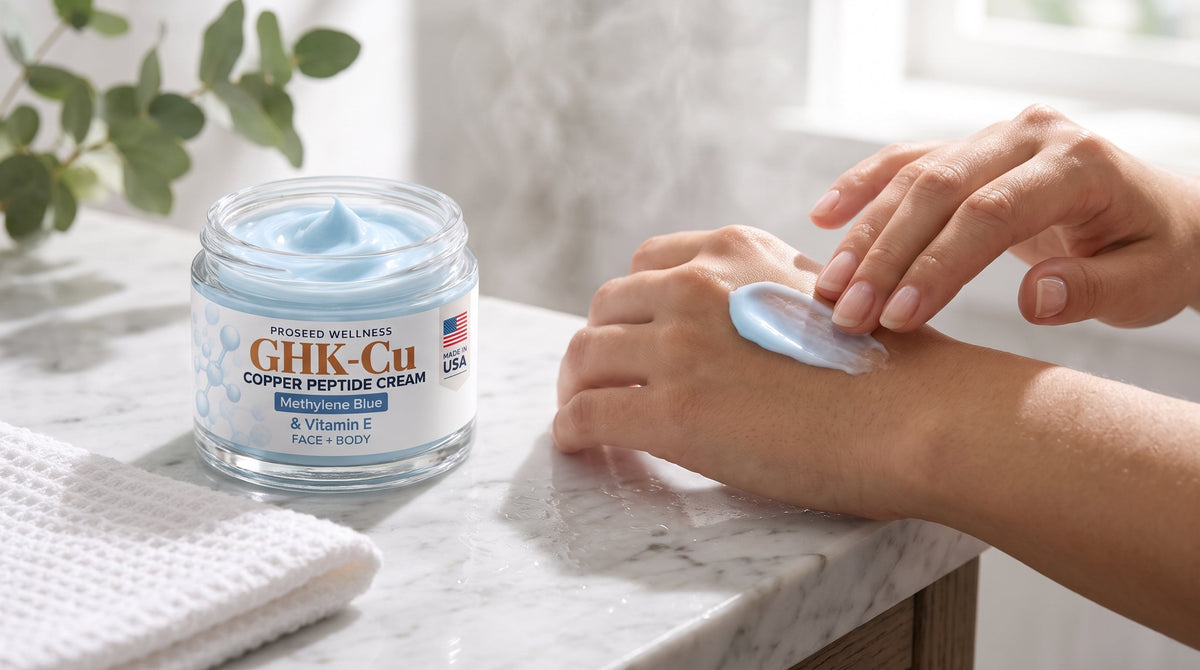
Why GHK-Cu Copper Peptides Outperform Retinol Without Irritation
In the quest for firmer, youthfully radiant skin, topical retinoids and harsh exfoliating acids have long dominated the conversation. Yet for millions dealing with sensitive, barrier-compromised, or mature skin, the trade-off—chronic peeling, redness, flaking, and heightened photo-sensitivity—is simply too disruptive.
Today, advanced dermatological science is shifting focus from aggressive surface peeling to cellular signaling and tissue remodeling. At the forefront of this biotechnology revolution is GHK-Cu (copper tripeptide-1).
Whether paired with antioxidant powerhouses like Methylene Blue or applied to restore depleted skin elasticity, copper peptides are redefining anti-aging skincare. In this comprehensive, research-backed guide, you will learn the biology of GHK-Cu, how it directly compares to retinol, how to layer it safely, and what makes a truly potent copper peptide formulation.
What Is GHK-Cu Copper Peptide?
Discovered in 1973 by Dr. Loren Pickart, GHK (glycyl-L-histidyl-L-lysine) is a naturally occurring tripeptide present in human plasma, saliva, and collagen tissue. In youth, high concentrations of GHK signal rapid tissue repair, cell turnover, and robust wound healing.
By age 60, however, natural levels of GHK decline by more than 60%.
When this tripeptide binds with copper ions ($Cu^{2+}$), it forms GHK-Cu—a bioavailable peptide complex with an affinity for cellular repair. Rather than merely hydrating surface layers, copper tripeptide-1 serves as an active cellular messenger that instructs fibroblasts to behave like younger cells.
4 Proven Mechanisms: How GHK-Cu Renews Aging Skin
Topical copper peptides do not just mask fine lines; they trigger an active cascade of dermal regeneration:
1. Upregulates Collagen & Elastin Synthesis
Unlike standard skincare ingredients that only stimulate Type I collagen, clinical studies reveal that GHK-Cu stimulates both Type I and Type III collagen, as well as elastin, proteoglycans, and glycosaminoglycans (GAGs). This dual stimulation restores tensile strength, firming sagging contours and softening deep-set creases.
2. Activates Extracellular Matrix (ECM) Remodeling
GHK-Cu acts as a biological "quality control" manager for your skin. It activates metalloproteinases (MMPs) to break down large, cross-linked, damaged collagen fibers (often caused by photo-damage or scarring) while simultaneously stimulating the synthesis of new, organized collagen bundles.
3. Neutralizes Oxidative Stress & Cellular Senescence
Copper is a fundamental cofactor for Superoxide Dismutase (SOD), one of the human body’s most critical endogenous antioxidant enzymes. Topical GHK-Cu boosts internal free radical defense, halting the oxidative chain reactions that lead to premature photo-aging and hyperpigmentation.
4. Calms Low-Grade Inflammation & Accelerates Barrier Repair
Unlike aggressive chemical peels that degrade the skin barrier to force cell turnover, GHK-Cu accelerates epidermal re-epithelialization. It suppresses pro-inflammatory cytokines, making it ideal for soothing post-procedure skin, rosacea-prone complexions, and barrier fatigue.
GHK-Cu Copper Peptides vs. Retinol: The Direct Comparison
For decades, dermatologists labeled retinol the "gold standard" for anti-aging. However, comparative clinical trials reveal a different picture when evaluating patient tolerance, firmness, and long-term barrier health.
| Criteria | Topical GHK-Cu Copper Peptides | Traditional Retinol / Retinoids |
| Primary Mechanism | Cellular signaling, ECM remodeling & collagen synthesis | Forced epidermal cell turnover & exfoliation |
| Barrier Integrity | Repairs lipid bilayer; calms inflammation | Disrupts barrier; often causes peeling & redness |
| Collagen Types Stimulated | Collagen Type I, Type III, and Elastin | Predominantly Collagen Type I |
| Skin Sensitivity | Low irritation; safe for reactive, thin skin | High irritation; requires slow acclimation |
| Sun Sensitivity | Non-photosensitizing; safe for daytime use | Increases photosensitivity; strictly evening use |
| Wound Healing | Accelerates healing post-microneedling/laser | Contraindicated on compromised, wounded skin |
In a landmark facial study comparing copper peptide creams to retinol, tretinoin, and vitamin C, GHK-Cu demonstrated greater increases in collagen production and skin density with zero reported peeling or skin discomfort.
The Synergistic Boost: Pairing GHK-Cu with Methylene Blue
Modern cosmetic formulation reaches its peak when intelligent cellular messengers work alongside mitochondrial revitalizers.
One of the most exciting breakthroughs in longevity skincare is the pairing of GHK-Cu with USP-grade Methylene Blue:
-
Methylene Blue targets the electron transport chain inside skin cell mitochondria, increasing cellular ATP production, reducing mitochondrial ROS (reactive oxygen species), and extending the biological lifespan of dermal fibroblasts.
-
GHK-Cu receives that cellular energy to fuel rapid structural synthesis of collagen and proteoglycans.
Together, this dual-blue complex works from the mitochondria outward to reverse visible skin thinning, loss of bounce, and micro-wrinkles.
Clinical Cellular Care: Discover our ultra-concentrated ProSeed GHK-Cu Copper Peptide Cellular Cream—formulated with pure bioavailable copper tripeptide-1 and skin-replenishing botanical lipids for complete age-defying skin health.
How to Layer GHK-Cu Copper Peptides in Your Routine
To ensure maximum absorption and maintain the active molecular structure of copper peptides, follow these professional application rules:
When to Apply
-
Morning or Evening: Because GHK-Cu does not increase sun sensitivity, you can use it morning, night, or both.
-
Application Order: Apply after cleansing and gentle water-based toners, but before heavy occlusives or facial oils.
Crucial Formulation Conflicts: What NOT to Mix with GHK-Cu
Copper ions are delicate coordination complexes. Direct exposure to certain unstable, low-pH acids can break the bond between the GHK peptide and the copper ion, rendering both ingredients inactive:
-
Direct L-Ascorbic Acid (Pure Vitamin C): Pure acidic vitamin C can chelate the copper and oxidize the formula. (Use Vitamin C in the AM and Copper Peptides in the PM, or opt for non-acidic lipid-soluble Vitamin C derivatives).
-
Strong AHA/BHA Chemical Exfoliants: Low-pH glycolic, salicylic, or lactic acid serums should be used on alternate nights rather than layered directly on top of copper peptides.
Frequently Asked Questions (FAQs)
Why is genuine copper peptide skincare blue?
Pure GHK-Cu is naturally an intense, royal blue color due to the copper ion bound to the peptide chain. If a copper peptide cream or serum is pure white or clear, it likely contains an infinitesimal trace amount insufficient to deliver clinical benefits.
Can I use copper peptides around my eyes?
Yes. Because GHK-Cu supports elastin production and microcapillary integrity without causing flaking or stinging, it is exceptionally beneficial for firming crepey undereye skin, softening crow's feet, and improving under-eye firmness.
How long does it take to see visible results from GHK-Cu?
Hydration and skin plumping are typically noticeable within 7 to 10 days. Significant structural changes—such as increased jawline firmness, reduction in fine line depth, and improved skin density—develop progressively over 8 to 12 weeks of daily use as new collagen matrices mature.
Transform Your Skin from the Inside Out
True skin longevity is not about stripping your delicate barrier—it is about providing your cells with the precise biological signals they need to rebuild, firm, and glow.
Experience the restorative synergy of clinical biotechnology and pure restorative care with ProSeed GHK-Cu Copper Peptide Cellular Cream.

Written by Buket Kaptan
Buket Kaptan holds a master’s degree in Complementary and Alternative Medicine. She is a NAHA-certified Professional Aromatherapist and Aromatherapy Educator, an AIA-certified Aromatherapist, and an academic member of the American Botanical Council. She is the founder of ProSeed Wellness and Buket Kaptan Aromatherapy and brings her background in aromatherapy and holistic wellness to thoughtful skincare education.

Leave a comment
This site is protected by hCaptcha and the hCaptcha Privacy Policy and Terms of Service apply.