
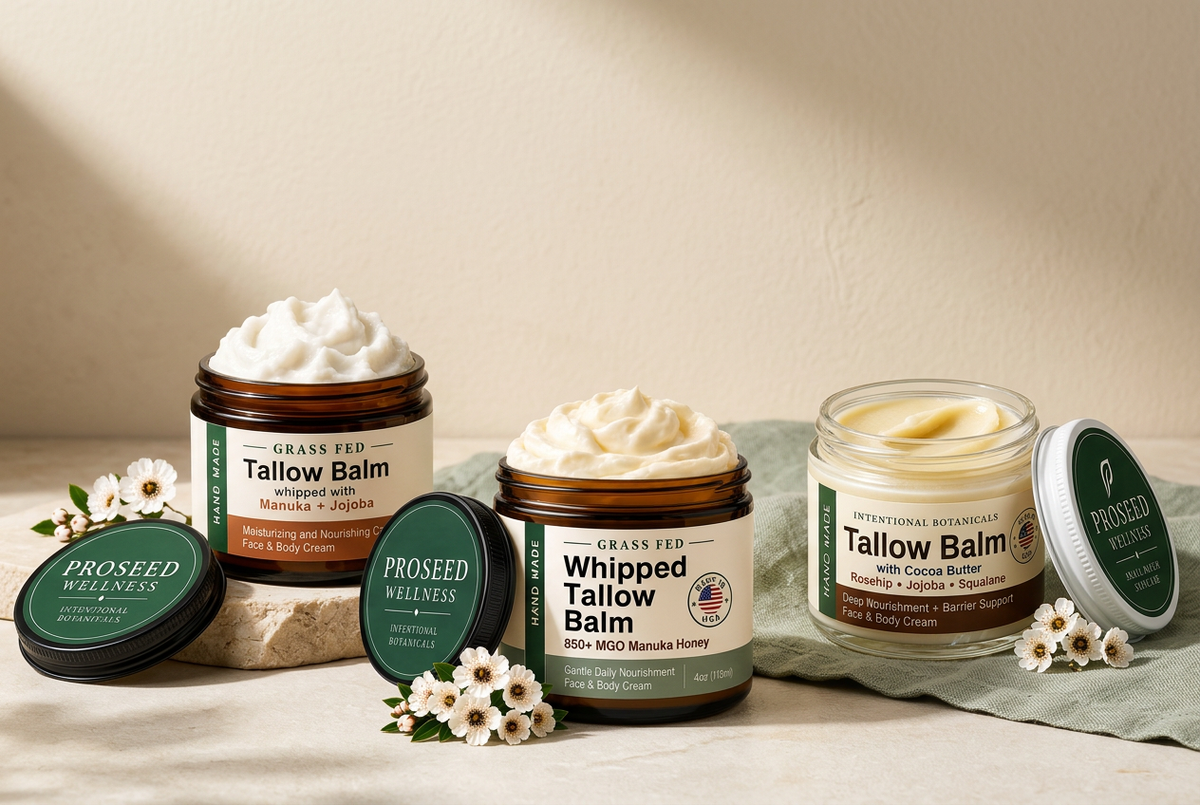
Why Grass-Fed Tallow Outperforms Plant Butters for a Damaged Skin Barrier
If you have ever dealt with a compromised skin barrier, you know the frustration: burning when applying basic lotions, persistent flaking, tight redness, and random inflammatory breakouts.
The conventional response in clean beauty is to layer heavy plant oils and seed butters—shea butter, cocoa butter, argan, or coconut oil. Yet for millions of people, plant-based occlusives sit right on top of the surface, creating an oily film while the deep stratum corneum remains parched and inflamed beneath.
Fixing a dysfunctional skin barrier requires matching the biological language of human skin. When evaluated under lipid chromatography, grass-fed beef tallow mirrors human sebum in ways plant botany simply cannot replicate.
Here is the dermatological science behind why grass-fed tallow consistently outperforms plant butters for barrier recovery, repair, and long-term lipid integrity.
The Biological Reality of a Damaged Barrier
Your skin barrier—the outermost layer called the stratum corneum—is structured like a brick wall:
- The "Bricks": Corneocytes (dead skin cells packed with keratin and natural moisturizing factors).
- The "Mortar": An intricate lipid matrix consisting roughly of 50% ceramides, 25% cholesterol, and 15% free fatty acids.
When harsh cleansers, environmental extremes, over-exfoliation, or chemical retinoids strip this lipid mortar, microscopic fissures form. Transepidermal Water Loss (TEWL) spikes, irritants penetrate, and the immune system responds with chronic inflammation.
Healing this state requires replacing missing intercellular lipids with bio-compatible fatty acids that slip seamlessly into the lamellar lipid bilayer.
Tallow vs. Plant Butters: The Lipid Comparison
Plant fats like shea, cocoa, and coconut butter contain valuable phytochemicals, but their underlying molecular profile differs significantly from mammalian tissue.

1. Bio-Identical Fatty Acid Distribution
Human sebum naturally contains high concentrations of palmitic acid (approx. 20–25%) and stearic acid (approx. 10–15%), alongside oleic acid. Grass-fed tallow exhibits an almost identical ratio of saturated to monounsaturated fatty acids. Because of this biological resonance, the lipid membrane recognizes tallow instantly. Rather than suffocating the epidermis, tallow integrates into the intercellular matrix, reinforcing structural integrity from within.
2. The Comedogenic Paradox
Many assume animal fats cause clogged pores, while plant butters are "clean." In practice, plant waxes and heavy butters like cocoa butter and coconut oil have high comedogenic ratings (3 to 4 out of 5) because their triglyceride sizes are foreign to our pore structure, trapping debris. Pure rendered grass-fed tallow has a low comedogenic profile (typically rated 2), absorbing thoroughly without leaving a sticky, non-breathable barrier.
3. Native Bioavailable Fat-Soluble Vitamins
Plant butters supply Vitamin E and beta-carotene (a plant precursor that human skin must convert to Vitamin A).
Because grass-finished cattle graze on sunlit pasture grasses, their suet stores pure, pre-formed fat-soluble vitamins:
- Natural Retinol (Vitamin A): Stimulates cellular turnover and collagen synthesis gently, without the irritation of synthetic retinoids.
- Vitamin D3: Orchestrates antimicrobial peptide production in the epidermis to soothe dermatitis and acne pathogens.
- Vitamin E (Tocopherol): Protects newly formed cell membranes against lipid peroxidation.
- Vitamin K2: Promotes skin elasticity and wound healing.
Head-to-Head: Grass-Fed Tallow vs. Common Plant Alternatives
| Feature / Benefit | Grass-Fed Suet Tallow | Shea Butter | Coconut Oil |
|---|---|---|---|
| Fatty Acid Profile | Saturated & monounsaturated (Bio-identical to sebum) | High stearic/oleic, low cellular mimicry | Lauric acid dominant (~50%) |
| Comedogenic Risk | Low (Integrates cleanly into pores) | Low-to-Moderate (Can congest oily profiles) | Very High (Pore-clogging for acne-prone skin) |
| Vitamin Delivery | Bioavailable Vitamins A, D3, E, and K2 | Pre-vitamin carotenoids & Vitamin E | Minimal fat-soluble micronutrients |
| Anti-Inflammatory Lipids | Rich in CLA (Conjugated Linoleic Acid) | Cinnamic acid esters | Monolaurin (Antimicrobial) |
| Transdermal Absorption | Deep dermal penetration into stratum corneum | Surface occlusive seal; slow absorption | Sits on top of skin; prone to drying long-term |
Why "Grass-Fed" Is Non-Negotiable
Not all tallow yields restorative results. Conventional, grain-fed feedlot cattle produce fat low in essential micronutrients and laden with inflammatory omega-6 fatty acids due to diets heavy in corn and soy.
In contrast, pasture-raised, grass-fed, and grass-finished suet (the nutrient-dense kidney fat) offers two critical therapeutic components:
- Conjugated Linoleic Acid (CLA): Grass-fed tallow holds significantly higher concentrations of CLA, an omega-6 isomer scientifically demonstrated to suppress pro-inflammatory cytokines and accelerate tissue re-epithelialization.
- Balanced Omega-3 to Omega-6 Ratio: Pasture feeding creates an optimal lipid environment that calms reactive conditions such as rosacea, perioral dermatitis, and eczema flare-ups.
How to Integrate Tallow Balm Into a Damaged Skin Barrier Routine
A little tallow goes a long way. Because tallow is 100% waterless, concentrated lipid nutrition, a pea-sized amount is sufficient for the entire face.
- Drench Skin with Hydration First: Lipids seal in hydration; they do not introduce water. Mist your face with a botanical hydrosol or apply a humectant (like a peptide serum or hyaluronic acid) to damp skin.
- Warm Between Fingertips: Take a tiny dab of ancestral grass-fed tallow balm and warm it between your fingers to melt it to body temperature.
- Press, Don’t Rub: Gently press the melted balm over irritated, dry, or peeling zones to lock in moisture and recreate the missing stratum corneum barrier.
- Targeted Night Treatment: For compromised skin barriers, apply as your final evening step to stop overnight trans epidermal water loss.
Frequently Asked Questions
Will applying beef tallow make my acne worse?
No, provided the tallow is pure, grass-fed, and properly rendered. Acne flare-ups often worsen when an impaired barrier lets opportunistic bacteria penetrate. Tallow’s natural antimicrobial fatty acids (like palmitoleic acid) and balanced lipid profile support the acid mantle without triggering the pore congestion associated with synthetic mineral oils or plant waxes.
Does grass-fed tallow balm smell like beef?
When crafted using artisanal dry-rendering and clinical purification methods, cosmetic-grade suet tallow has a very subtle, mild, clean scent. Blended with therapeutic-grade botanicals like blue tansy, vanilla, or Manuka honey, any faint natural aroma is balanced into an earthy, luxurious balm.
How does tallow compare to medical-grade petrolatum (slugging)?
Petrolatum is an inert byproduct of the crude oil refining industry. While it creates an impenetrable physical seal against water loss, it provides zero active nutrients, vitamins, or fatty acids to nourish the skin. Tallow is an active occlusive: it stops trans epidermal water loss while simultaneously feeding damaged cells the exact lipid building blocks needed to rebuild the barrier naturally.
Restore your skin barrier with real cellular nutrition. Explore our handcrafted line of Pasture-Raised Grass-Fed Tallow Balms, formulated by certified clinical herbalists for sensitive, compromised skin.

Written by Buket Kaptan
Buket Kaptan holds a master’s degree in Complementary and Alternative Medicine. She is a NAHA-certified Professional Aromatherapist and Aromatherapy Educator, an AIA-certified Aromatherapist, and an academic member of the American Botanical Council. She is the founder of ProSeed Wellness and Buket Kaptan Aromatherapy and brings her background in aromatherapy and holistic wellness to thoughtful skincare education.

Leave a comment
This site is protected by hCaptcha and the hCaptcha Privacy Policy and Terms of Service apply.