
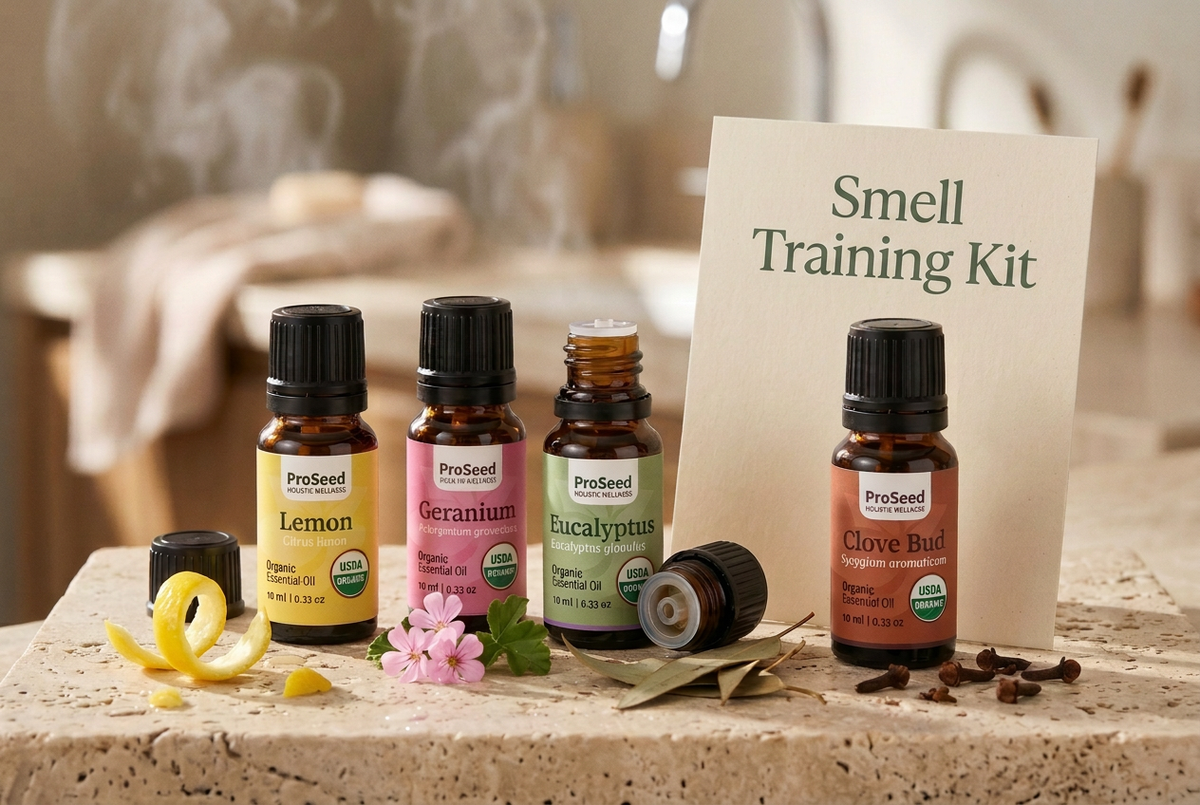
How to Retrain Your Sense of Smell After COVID or the Flu: The Science of Olfactory Retraining
Losing your sense of smell after a bout with COVID-19, influenza, or a severe upper respiratory infection can be deeply disorienting. Food loses its flavor, comforting scents disappear, and vital environmental safety cues—like smoke or spoiled food—are suddenly silenced.
In clinical neurology, a complete loss of smell is categorized as anosmia, partial loss as hyposmia, and distorted perception—where coffee, eggs, or tap water smell foul, chemical, or burnt—is termed parosmia.
When spontaneous recovery stalls, peer-reviewed medical research indexed in PubMed confirms that the most effective, evidence-based, non-invasive therapeutic intervention available is structured olfactory retraining (Addison et al., 2021; PubMed PMID: 33453291).
Why Upper Respiratory Viruses Disrupt Smell: The Cellular Evidence
A common misconception is that post-viral sensory loss is caused by excess nasal mucus physically blocking odorants. While acute congestion creates mechanical obstruction during the initial days of infection, chronic post-viral anosmia is cellular and neurological.
A landmark study published in Science Advances (Brann et al., 2020; PubMed PMID: 32937591) identified the exact pathophysiological mechanism:
Respiratory viruses like SARS-CoV-2 do not directly express ACE2 receptors on the sensory neurons themselves.
Instead, they target and infect the adjacent sustentacular cells—the metabolic and structural scaffolding that nourishes and insulates olfactory neurons.
When sustentacular cells suffer acute inflammatory damage, the microvilli and cilia lining the olfactory cleft collapse. As a result, the sensory neurons lose their metabolic support, interrupting electrical signal transduction to the brain’s olfactory bulb.
Fortunately, olfactory sensory neurons are among the few neuronal populations in the human body capable of lifelong neurogenesis. Under the right physiological conditions, stem cells in the basal layer of the olfactory epithelium divide and differentiate into mature sensory neurons, reconnecting with the central nervous system. Olfactory training functions as targeted sensory physical therapy that guides this neuroplastic re-wiring.
The Clinical Framework: The Hummel Protocol & PubMed Data
Clinical Evidence: The Damm et al. Trial
Damm et al. (Laryngoscope, 2014; PubMed PMID: 23929687) conducted a randomized, controlled, multicenter study of 144 patients with postinfectious olfactory dysfunction.
Study Design: Participants trained with four odors at either high or low concentrations for 18 weeks, then switched concentration groups for another 18 weeks.
Clinical Findings: After the first 18 weeks, olfactory function improved in 26% of the high-concentration group and 15% of the low-concentration group. Among participants whose smell loss had lasted less than 12 months, improvement occurred in 63% and 19%, respectively. The findings support olfactory training for postinfectious smell loss and suggest that odor concentration and timing may influence outcomes.
In 2009, a pioneering clinical trial led by Dr. Thomas Hummel and colleagues at the Interdisciplinary Center for Smell and Taste at the Dresden University of Technology established the foundation of modern smell therapy (Laryngoscope, 2009; PubMed PMID: 19235739).
The Landmark 2009 Dresden Study:
Cohort: Patients suffering from post-infectious, post-traumatic, and idiopathic olfactory loss.
Intervention: Twice-daily exposure to four defined odor quadrants for 12 consecutive weeks.
Diagnostic Measure: Pre- and post-trial Sniffin' Sticks testing, evaluating three clinical metrics: Odor Threshold, Odor Discrimination, and Odor Identification (the TDI score).
Findings: A statistically significant majority of patients in the olfactory training group showed objective improvement in their TDI scores compared to untrained controls, demonstrating that olfactory pathways can be systematically rehabilitated through focused scent exposure.
Validation in Post-COVID Anosmia:
A comprehensive systematic review and meta-analysis published in Otolaryngology–Head and Neck Surgery (Kattar et al., 2021; PubMed PMID: 32660334) evaluated multiple randomized and prospective studies on post-viral smell loss. The researchers concluded that olfactory training produced clinically meaningful improvements in olfactory function, with significantly higher rates of clinically relevant TDI recovery compared to observation alone.
Lechien, Vaira, and Saussez studied 57 patients with persistent smell dysfunction after COVID-19 in a prospective study published online in 2022 and in the 2023 volume of European Archives of Oto-Rhino-Laryngology (doi: 10.1007/s00405-022-07665-4). Adherence to olfactory training was associated with better mid-term improvement in objective smell-test scores. Perceived recovery time and the occurrence of parosmia were comparable between groups; the authors called for larger randomized controlled studies.
The 4 Aromatic Quadrants (The Odour Prism)
The Hummel Protocol employs Henning’s classic Odour Prism, systematically engaging four distinct sensory receptors across the nasal cavity:
                  ┌──────────────────────┐
                  │    FRUITY / CITRUS   │
                  │     (Lemon Oil)      │
                  └──────────┬───────────┘
                             │
     ┌───────────────────────┼───────────────────────┐
     │                                               │
┌────┴─────────────────┐                   ┌─────────┴────────────┐
│        FLORAL        │                   │ RESINOUS / CAMPHORIC │
│    (Geranium Oil)    │                   │   (Eucalyptus Oil)   │
└──────────────────────┘                   └─────────┬────────────┘
                                                     │
                             ┌───────────────────────┘
                  ┌──────────┴───────────┐
                  │        SPICY         │
                  │     (Clove Oil)      │
                  └──────────────────────┘
Using 100% pure, unadulterated botanical essential oils is critical. Synthetic perfumes or alcohol-based fragrances introduce artificial chemical isolates that distort sensory input and send confusing signals to the regenerating olfactory cortex.
1. The Fruity / Citrus Quadrant: Organic Lemon (Citrus limon)
Dominant Terpene: d-limonene
Neurological Mechanism: Stimulates anterior olfactory pathways with bright, volatile monoterpenes, activating the front quadrant of the olfactory bulb.
2. The Floral Quadrant: Organic Geranium (Pelargonium graveolens)
Dominant Terpenes: geraniol and citronellol
Neurological Mechanism: While classic European studies often utilized synthetic phenylethyl alcohol (rose aroma), clinical aromatherapists prefer pure steam-distilled Egyptian geranium. Its natural geraniol profile exercises the brain’s ability to differentiate soft, layered botanical nuances without synthetic fixatives.
3. The Resinous / Camphoric Quadrant: Organic Eucalyptus (Eucalyptus globulus)
Dominant Terpene: 1,8-cineole (eucalyptol)
Neurological Mechanism: Stimulates cross-talk between the olfactory nerve (Cranial Nerve I) and the ophthalmic/maxillary branches of the trigeminal nerve (Cranial Nerve V). Research indicates this trigeminal-olfactory synergy acts as a sensory primer, opening nasal passages and sharpening conscious detection.
4. The Spicy Quadrant: Organic Clove Bud (Syzygium aromaticum)
Dominant Terpenes: eugenol and beta-caryophyllene
Neurological Mechanism: Provides a heavy, warm, pungent phenolic profile that activates basal olfactory receptors, anchoring the lower end of the sensory spectrum.
Formulated for Evidence-Based Recovery: Experience all four certified organic, single-origin oils alongside our clinical protocol guide in the ProSeed USDA Organic Olfactory Smell Training Kit.
Step-by-Step Clinical Protocol (Twice Daily)
Follow this 5-minute protocol twice daily—once in the morning and once in the evening—for a minimum of 12 to 16 consecutive weeks.
1. Establish an Odor-Neutral Baseline
Sit upright in a quiet room free from food aromas, ambient candles, or drafts. Take two calm breaths through your mouth to clear your airway.
2. The "Bunny Sniff" Inhalation
Open the first bottle (e.g., Lemon) and hold the rim 1 to 2 inches beneath your nostrils.
Take gentle, rapid, shallow sniffs for 15 to 20 seconds.
Clinical Note: Avoid deep, forceful inhalations. Shallow sniffs generate micro-turbulences in the nasal vault, keeping volatile molecules concentrated in the olfactory cleft rather than pulling them directly into the lungs.
3. Active Cognitive Visualization (Top-Down Neuroplasticity)
A study in NeuroImage (Djordjevic et al., 2005; PubMed PMID: 15652314) revealed that mental odor imagery activates the primary olfactory cortex (piriform cortex) even in the absence of a physical scent.
While sniffing, actively visualize the source material. Imagine slicing a vibrant, yellow lemon and smelling the burst of citrus oils from the peel.
Searching your memory for the authentic scent while the physical molecules enter the nose accelerates the re-establishment of severed neural connections.
4. Inter-Stimulus Rest & Sequence
Cap the bottle and rest for 30 seconds, breathing neutral room air to prevent olfactory receptor adaptation (fatigue). Move sequentially through the remaining oils:
Lemon (Citrus)
Geranium (Floral)
Eucalyptus (Resinous / Camphoric)
Clove (Spicy)
Understanding Parosmia: The Biological Marker of Repair
Many individuals in post-viral recovery encounter parosmia—where everyday items like roasted coffee, sautéed garlic, or tap water take on a sickening chemical, burnt, or rotten aroma.
Although deeply distressing, peer-reviewed clinical literature (e.g., Parker et al., Communications Medicine, 2022; PubMed PMID: 35647609) identifies parosmia as a sign of active, imperfect axonal regeneration.
As immature sensory neurons send new axons from the nasal lining through the cribriform plate to the olfactory bulb, they do not all reconnect simultaneously or in perfect alignment. Signals arrive incomplete, and the sensory cortex interprets this partial pattern as a sensory alert (often foul or burnt).
Clinical Rule: Do not discontinue training if parosmia occurs. Consistent exposure to pure, stable botanical terpenes provides the neurological baseline your brain requires to recalibrate these crossed signals over time.
Frequently Asked Questions (Backed by Science)
How long does clinical olfactory retraining take?
According to data compiled by Hummel et al. (Rhinology, 2017; PubMed PMID: 28623665), peripheral olfactory neurons regenerate slowly—often over several months. While some patients observe early sensory shifts within 4 to 6 weeks, maximum clinical recovery typically requires 12 to 24 weeks of disciplined, twice-daily practice.
Can I substitute kitchen spices or ground coffee?
Household spices, dried herbs, and ground coffee lose their volatile compounds rapidly upon air exposure and lack standardized chemical profiles. In clinical trials, stable, concentrated botanical oils ensure that identical molecular concentrations reach receptor sites during every training session.
What if I cannot detect any scent at all during the first month?
This is normal for post-viral anosmia. Even when sub-conscious perception remains below your conscious detection threshold, airborne volatile terpenes continue to bind to recovering receptor sites. Combining this exposure with active cognitive visualization stimulates neural pathways and supports ongoing neurogenesis.
Rebuild Your Sensory Pathways
Sensory recovery is not a passive waiting game; it is an active rehabilitation process backed by modern clinical otolaryngology. Through twice-daily practice, focused cognitive visualization, and pure botanical essences, you give your nervous system the tools it needs to reconnect.
Begin your recovery journey with the ProSeed USDA Organic Olfactory Smell Training Kit—curated by clinical aromatherapists to help you rediscover life's richest aromas.
Verified Clinical References & Scientific Literature
Brann, D. H., Tsukahara, T., Weinreb, C., Lipovsek, M., Van den Berge, K., Gong, B., et al. (2020). Non-neuronal expression of SARS-CoV-2 entry genes in the olfactory system suggests mechanisms underlying COVID-19-associated anosmia. Science Advances, 6(31), eabc5801.
PubMed PMID: 32937591
Hummel, T., Rissing, K., Nordin, S., & Hüttenbrink, K. B. (2009). Effects of olfactory training in patients with olfactory loss. The Laryngoscope, 119(3), 496–499.
PubMed PMID: 19235739
Kattar, N., Do, T. M., Unis, G. D., Migneron, M. R., Thomas, A. J., & McCoul, E. D. (2021). Olfactory training for postviral olfactory dysfunction: Systematic review and meta-analysis. Otolaryngology–Head and Neck Surgery, 164(2), 244–254.
PubMed PMID: 32660334
Addison, A. B., Wong, B., Ahmed, T., Macchi, A., Konstantinidis, I., Huart, C., et al. (Clinical Olfactory Working Group). (2021). Clinical Olfactory Working Group consensus statement on the treatment of postinfectious olfactory dysfunction. Journal of Allergy and Clinical Immunology, 147(5), 1704–1719.
PubMed PMID: 33453291
Djordjevic, J., Zatorre, R. J., Petrides, M., Boyle, J. A., & Jones-Gotman, M. (2005). Functional neuroimaging of odor imagery: Human brain activation during odor mental representation. NeuroImage, 24(3), 791–801.
PubMed PMID: 15652314
Parker, J. K., Kelly, C. E., & Gane, S. B. (2022). Insights into the molecular triggers of parosmia based on gas chromatography olfactometry. Communications Medicine, 2, 58. doi: 10.1038/s43856-022-00112-9.
PubMed PMID: 35647609
Hummel, T., Whitcroft, K. L., Andrews, P., Altundag, A., Cinghi, C., Costanzo, R. M., et al. (2017). Position paper on olfactory dysfunction. Rhinology, 54(26), 1–30.
PubMed PMID: 28623665
Patel, Z. M., Wise, S. K., & DelGaudio, J. M. (2017). Randomized Controlled Trial Demonstrating Cost-Effective Method of Olfactory Training in Clinical Practice: Essential Oils at Uncontrolled Concentration. Laryngoscope Investigative Otolaryngology, 2(2), 53–56. doi: 10.1002/lio2.62.
PubMed PMID: 28894822
Lechien, J. R., Vaira, L. A., & Saussez, S. (2023; published online 2022). Effectiveness of olfactory training in COVID-19 patients with olfactory dysfunction: a prospective study. European Archives of Oto-Rhino-Laryngology, 280, 1255–1263. doi: 10.1007/s00405-022-07665-4.
Written by Buket Kaptan
Buket Kaptan holds a master’s degree in Complementary and Alternative Medicine. She is a NAHA-certified Professional Aromatherapist and Aromatherapy Educator, an AIA-certified Aromatherapist, and an academic member of the American Botanical Council. She is the founder of ProSeed Wellness and Buket Kaptan Aromatherapy and brings her background in aromatherapy and holistic wellness to thoughtful skincare education.

Leave a comment
This site is protected by hCaptcha and the hCaptcha Privacy Policy and Terms of Service apply.